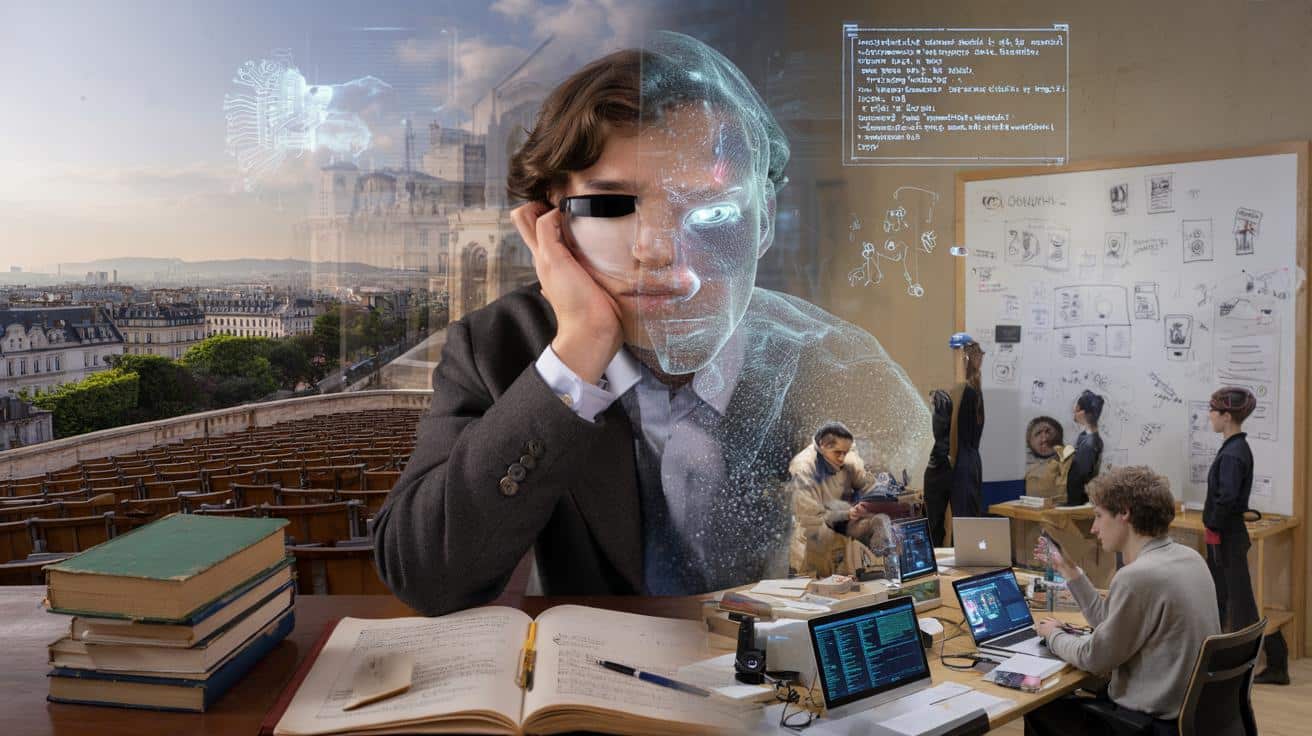
From San Francisco to Paris, tech leaders and high-profile thinkers are questioning whether years spent in lecture halls still make sense when artificial intelligence can code, write and analyse faster than many graduates. Their argument is starting to echo loudly in France, where the prestige of long academic study has long shaped careers and social status.
Silicon Valley’s new gospel: drop out, start building
In late 2025, at a packed tech conference, Sam Altman, the face of ChatGPT and CEO of OpenAI, praised Gen Z students who had simply walked away from university. He admitted feeling “envious” of those who had abandoned formal studies, arguing that the freedom and opportunity they now enjoyed were unprecedented.
Altman was not speaking in the abstract. He himself left university at 19. His story fits a familiar narrative in American tech culture: the dropout visionary. Bill Gates and Mark Zuckerberg famously quit Harvard. Alexandr Wang, the young billionaire who now oversees artificial intelligence at Meta, left the Massachusetts Institute of Technology at the same age.
These biographies are held up as proof that, in tech at least, the fastest route to success may be outside the classroom, not inside it.
In Silicon Valley, this idea has hardened into a kind of counter‑orthodoxy. If you are talented, so the thinking goes, you should spend your early twenties launching products, not revising for exams.
A French shock book that declares the “death of the diploma”
This discourse is no longer confined to California. In France, a country that has historically worshipped formal credentials, a recent book has thrown petrol on the debate. The title is blunt: Ne faites plus d’études. Apprendre autrement à l’ère de l’IA (“Stop studying. Learn differently in the age of AI”), published in 2025 by Buchet‑Chastel.
Its co‑authors are controversial and influential. Laurent Alexandre is a vocal transhumanism advocate, a movement that seeks to “enhance” humans through technology, and a regular interlocutor of far‑right leader Jordan Bardella. Olivier Babeau is an essayist and professor at the University of Bordeaux. Together, they issue a clear verdict: the diploma is dead.
They argue that for decades, higher education was the surest route to social mobility and economic stability. In their view, that contract has broken. The traditional degree, they claim, “no longer counts for anything” in an economy transformed by AI and continuous technological disruption.
Their core message: in an AI‑driven society, the value of static knowledge falls, while adaptability and rapid, self‑directed learning rise.
➡️ A psychologist explains how sensory deprivation reawakens intuition and deep self-awareness
➡️ The finding of white rocks on Mars supports the idea of a tropical climate 3 billion years ago
➡️ This quiet environmental cue tells plants when to slow down
➡️ How to create a tiny terrarium ecosystem that waters itself and stays balanced for years
➡️ The entryway pause that clears clutter: why a few seconds prevent hallway mess
Why this message hits differently in France
The argument lands in a country where academic credentials are woven into the fabric of public life. France’s elite civil servants, senior executives and political leaders are often products of “grandes écoles”, hyper‑selective institutions that act as gateways to power.
That makes the anti‑degree narrative both provocative and oddly seductive. Many young French people feel caught in a system where success means surviving years of competitive exams, rigid programmes and unpaid internships, often with no guarantee of stable employment at the end.
When tech figures insist that talent matters more than a certificate, some hear a promise of liberation. Others see a dangerous illusion that risks widening inequality between those who can navigate unconventional paths and those who cannot afford to fail.
AI as the accelerant: what changes, what doesn’t
Artificial intelligence is the backdrop to this entire debate. Tools like ChatGPT automate tasks that used to be the domain of junior graduates: drafting, coding, summarising complex documents, scanning legal texts or medical literature.
- For employers, this can reduce the value of generic, textbook knowledge.
- For students, it raises doubts about spending years acquiring content that machines handle instantly.
- For universities, it challenges the way courses are assessed and updated.
The dropout narrative suggests that in such a landscape, what counts is not the diploma but the portfolio: products shipped, code written, communities built. Silicon Valley loves anecdotes of teenagers who learned online, launched a start‑up and raised millions before they could legally order a drink.
Yet the picture is uneven. AI also increases the value of high‑level expertise in areas such as ethics, law, advanced mathematics, medicine and governance. Degrees in those fields still open doors that are hard to push without formal training.
Between myth and reality: who can really “skip” university?
Behind the glamorous stories of billionaire dropouts lies a harsher reality. Gates and Zuckerberg did not walk away from just any university; they left Harvard, already carrying powerful networks and family safety nets.
In France, a student leaving an engineering school in Lyon or a business school in Lille does not automatically gain access to venture capital and Silicon Valley mentors. They may end up in precarious gig work, with no diploma and no clear path back into the system.
The risk is that the “no more studies” message speaks loudest to those with the least margin for error.
Labour economists often point out that, on average, degrees still correlate strongly with higher earnings and lower unemployment, even if the premium is shrinking in some sectors. The standout stories of billionaire dropouts are statistically tiny outliers, not templates.
What French students are actually doing
Rather than abandoning university en masse, many French students are hedging. They keep their degree but tweak the way they learn and work.
Typical strategies include:
- Launching side projects or start‑ups while still enrolled.
- Using AI tools to accelerate work and free time for internships.
- Choosing shorter, vocational programmes over five‑year elite tracks.
- Following online courses in coding, design or data alongside traditional studies.
This hybrid approach reflects a more cautious reading of the Silicon Valley script. Students want flexibility and practical skills, but few are ready to burn their bridges with the formal system altogether.
Who benefits most from the anti‑degree discourse?
The “death of the diploma” narrative lines up neatly with the interests of some tech firms. If credentials lose weight, companies can justify hiring younger, cheaper workers without long experience. They can also recruit globally, focusing on skills tests rather than accredited programmes.
Some critics in France worry that such rhetoric weakens public universities and encourages a shift towards private bootcamps and corporate training academies. Those alternatives can be dynamic and efficient, but they are often expensive and minimally regulated.
| Path | Potential advantages | Main risks |
|---|---|---|
| Traditional long degree | Recognised credential, broad knowledge, access to networks and public sector roles | Cost, time, slow adaptation to fast tech changes |
| Early dropout, start‑up path | Speed, real‑world learning, potential high upside if venture succeeds | High failure rate, weak safety net, harder return to formal careers |
| Hybrid: degree + self‑learning | Diversified skills, recognised diploma, flexibility to pivot | Heavy workload, risk of burnout, unclear priorities |
Key concepts behind the debate
Several ideas sit quietly beneath this noisy conversation and shape how politicians, parents and students react.
Transhumanism and the cult of enhancement
Laurent Alexandre’s involvement ties the degree debate to transhumanism, a movement that promotes using technology to enhance physical and cognitive abilities. In that worldview, human capital is something to be constantly upgraded.
From this angle, a fixed, four‑ or five‑year period of study looks outdated. Learning should be continuous, modular, tightly coupled with the latest tools. Diplomas, issued once and for all, appear as relics of a slower age.
Signalling versus skills
Economists often describe degrees as “signals”. A diploma does not only reflect what you know; it signals traits such as persistence, conformity to rules and basic intellectual capacity. AI challenges the neatness of that signal.
If a chatbot can pass certain exams or produce polished essays, grades alone say less about what a human actually understands. That pushes employers to look for different proofs of skill: live coding tests, trial periods, project portfolios, peer recommendations.
Practical scenarios for young people weighing their options
A French high‑school graduate in 2026 faces a more complex decision tree than their parents did. One realistic scenario is to start a degree while setting clear checkpoints: after one or two years, they can reassess based on what they have learned, the state of the job market and whether side projects are gaining traction.
Another scenario is to commit to a shorter, skills‑focused programme—such as a two‑year technical diploma or design school—while using AI tools to build a strong online portfolio. This creates a middle path: tangible proof of ability plus an accredited qualification.
The harshest scenario is quitting early without a plan, no savings and no support network, relying on viral success that never comes.
For those tempted by the Silicon Valley story, one concrete step is to test the waters before burning bridges: try freelance work, open‑source contributions or a modest start‑up project during holidays. The outcome offers real‑world feedback about whether skipping further study looks like a brave move or a gamble too far.
Where the debate goes next
The clash between formal education and the AI‑fuelled dropout narrative will not be settled soon. France remains attached to competitive exams, ranked schools and carefully structured careers. At the same time, the tech sector’s disruptive ethos, amplified by high‑profile figures like Altman and Alexandre, has already started reshaping how young people think about learning, risk and success.
The next few years will test whether degrees adapt fast enough to stay relevant, or whether the promise of “learning differently” in the age of AI shifts from provocation to mainstream practice on both sides of the Atlantic.