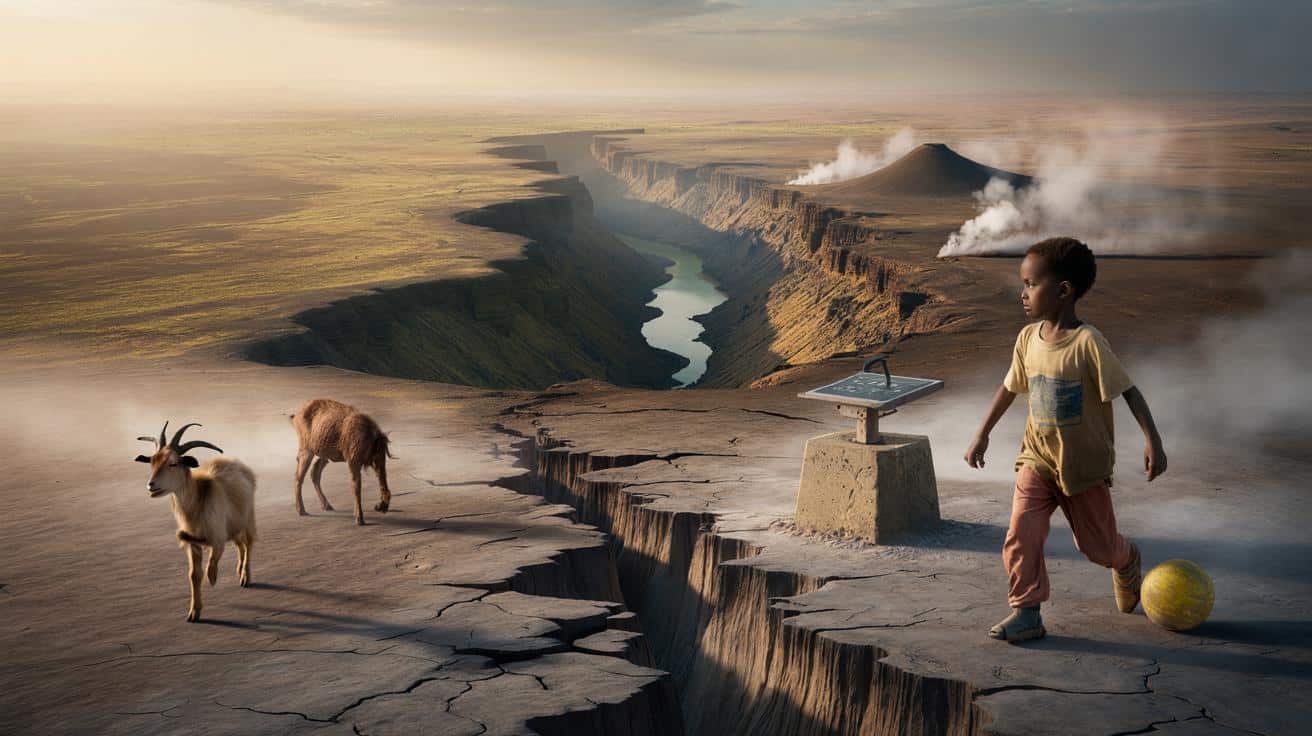
On a dusty morning near Ethiopia’s Afar Triangle, the ground looks perfectly still. A goat grazes, a child runs past with a plastic ball, and the sun rises over cracked basalt as it has for millions of years. Nothing hints at catastrophe or drama. Yet under those bare feet and plastic sandals, something enormous is happening in slow motion.
Satellites now detect the African continent stretching and tearing by millimeters each year, like a sheet of dough pulled gently from both sides. No human can feel it. No phone vibrates.
Still, the numbers don’t lie: Africa is literally splitting, and the process has already started.
A continent that looks calm, but is already moving
The story usually begins with that viral photo: a giant crack opening in a Kenyan field in 2018, slicing a road in two. People shared it with captions like “Africa is splitting in half!” and “A new ocean is coming!” It felt like a movie trailer, something out of a disaster film.
On the ground, though, the scene was messier and more human. Curious locals walked along the edges of the fissure, some laughing nervously, others filming with old smartphones. Scientists rushed to explain that the crack was partly due to rain and erosion, yet they all agreed on one simple fact. The land really is under tension.
The place where this quiet drama plays out has a name: the East African Rift System. It runs thousands of kilometers from the Afar region in the north, down through Ethiopia, Kenya, Uganda, Rwanda, Tanzania and beyond. It’s not one neat line, but a tangled set of fractures, volcanoes and stretched crust.
Geologists now use GPS stations anchored in rock to watch the land slide very, very slowly apart. Some points move just a few millimeters per year. That sounds like nothing, yet over a human lifetime it already adds up to centimeters. Over millions of years, it reshapes maps.
What’s going on beneath all this is brutally simple. The African tectonic plate is being pulled in different directions by deep convection currents in the mantle. Where the crust thins, magma rises, volcanoes form, and the surface starts to sag and crack. That’s why this rift is dotted with volcanoes like Erta Ale in Ethiopia and Ol Doinyo Lengai in Tanzania, and with long, narrow lakes like Tanganyika and Malawi.
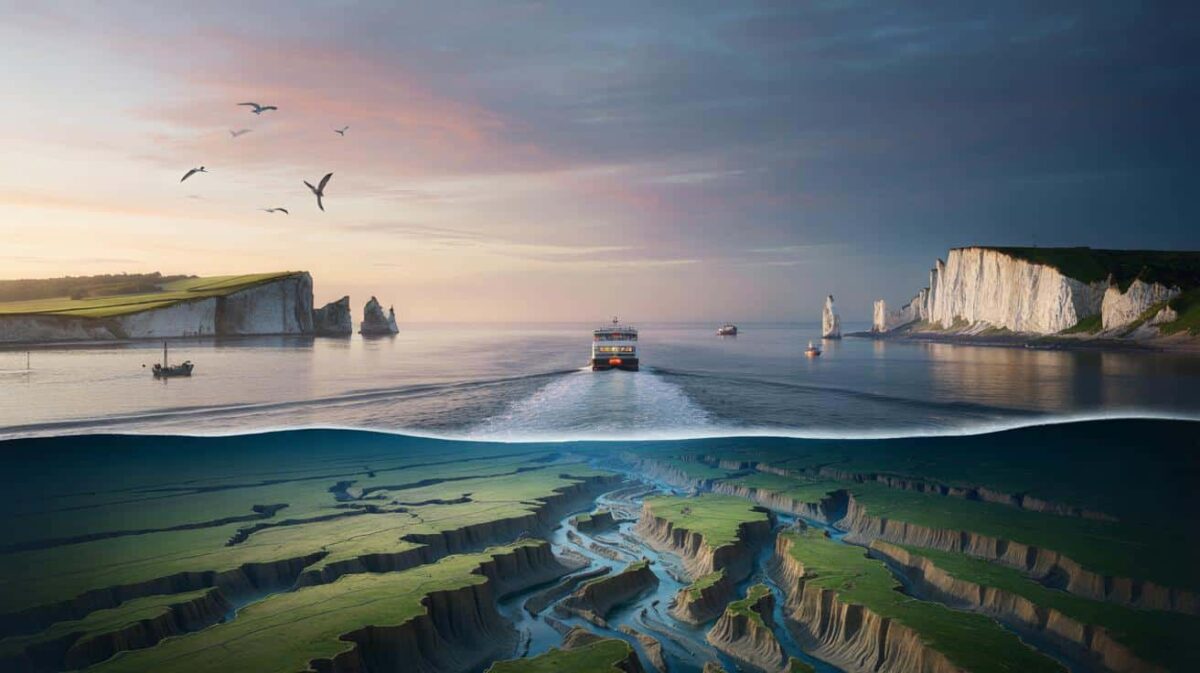
Scientists expect that one day, the eastern part of Africa will peel away from the rest of the continent, letting the sea rush in to form a new ocean basin. Oceans are born this way: not with a bang, but with a steady, relentless stretch.
How we already “see” a split that will take millions of years
The method scientists use is oddly humble: they essentially treat Africa like a patient on long-term monitoring. Small GPS antennas, often bolted to concrete pillars or bedrock, stay in place year after year. Each one whispers its position to satellites with absurd precision, tracking changes down to a few millimeters.
➡️ I made this hearty recipe and felt instantly relaxed after eating it
➡️ Inheritance : the new law arriving in February reshapes rules for heirs
➡️ How to create a tiny terrarium ecosystem that waters itself and stays balanced for years
➡️ Boiling lemon peel, cinnamon and ginger : why people recommend it and what it’s really for
➡️ The Norfolk home of the grandmother of Diana, Princess of Wales, has come to the market
If you map those tiny shifts over time, a pattern appears. Some stations slide slightly east, others slightly west, carving that telltale signature of a continent in tension. *For something that sounds so dramatic, it expresses itself as a quiet change in numbers on a screen.*
People often imagine tectonic shifts only when they feel an earthquake, but we actually “see” the African split far more clearly through patient measurement. There’s a kind of irony here. A farmer in Kenya or Ethiopia might never sense anything beyond a few tremors and the usual rumble of daily life. Yet thousands of kilometers away, a geophysicist staring at colored graphs can say, with calm confidence, that the ground under that farmer is drifting.
We’ve all been there, that moment when you realize something huge has been happening in the background for years and you only just noticed. Continental drift is like that, just on a grander, almost absurd scale.
The plain truth is that the real drama is in the timescale. Geologically, this kind of rifting can go from a crack to a full ocean basin in 10 to 20 million years. For us, that feels like forever. For the planet, it’s a busy weekend. So the split is both already measurable and almost frozen to the human eye.
Geologists explain that what we’re seeing in East Africa looks a lot like the early stages of the Red Sea or even the Atlantic, back when South America and Africa were still joined. **Today’s rift valleys are tomorrow’s coastlines.** The people living there are effectively walking across a draft version of a map that future civilizations will take for granted.
Living with a continent that refuses to stay still
So what do you actually do with this knowledge, beyond saying “wow” and scrolling on? One practical step is surprisingly simple: pay more attention to where things are being built. Engineers, planners and even road builders across East Africa are already having to factor in the rift, not as a sci‑fi scenario but as a real, ongoing condition.
That can mean reinforcing roads and bridges in zones where the ground is slowly sagging or shifting. It can also mean choosing safer places for critical infrastructure, away from active fault lines and the most restless volcanoes. One carefully chosen map can prevent a lot of future repair bills.
For locals, this slow-motion split also ties into everyday concerns: water, farming, tourism, housing. Rift lakes are deep reservoirs, but their levels and chemistry are shaped by the tectonic system below. A new hot spring or a small swarm of earthquakes can unsettle a community that already lives with droughts, floods, and changing seasons.
Let’s be honest: nobody really reads a scientific report before deciding where to build a house or plant maize. That’s where communication matters. When scientists talk about millimeters per year and “rift propagation”, many people just hear distant noise. Turning that into clear advice — “don’t put a hospital right here, put it 5 kilometers over there” — is an act of care, not alarmism.
The Kenyan geologist David Adede once summed it up in a field briefing: “Africa is not breaking overnight. But the ground is speaking to us, and we’d be foolish not to listen.”
- Understand where the rift runsBasic maps of the East African Rift are freely available. Knowing if your town, project or next trip sits on an active fault line changes how you read that landscape.
- Watch the quiet signsNew fumaroles, persistent small tremors, unexpected ground cracks after rain — individually they may be minor, together they sketch the stress the crust is under.
- Follow local expertsRegional universities and geological surveys in Ethiopia, Kenya, Tanzania and neighboring countries routinely publish updates. Their work turns satellite data into usable, local insight.
- Think long, build smartEven if the big split lies millions of years ahead, planning infrastructure with the rift in mind can save money, lives and frustration across the coming decades.
A slow drama that quietly rewrites the map
The strange thing about Africa’s tectonic split is that it invites two completely different reactions at once. On one hand, it’s almost comforting: no sudden apocalypse, no continent cracking in front of our eyes, just patient, measurable motion. On the other hand, it shrinks our sense of permanence. Cities, borders, even the shapes of countries are revealed as temporary, like doodles on a balloon that’s slowly stretching.
Somewhere in the Afar lowlands, a child is learning to walk on land that will, very slowly, become a coastline. Fishermen on Lake Tanganyika are already working on a proto‑ocean trench. The GPS antennas bolted into dusty hills will keep whispering their millimeter updates long after we are gone.
**The split is real, it’s happening now, and it reminds us that the ground we call solid is, in the long run, just another moving surface.** Knowing that doesn’t change your commute tomorrow. It does change how you picture the planet under your feet — restless, patient, and always under construction.
| Key point | Detail | Value for the reader |
|---|---|---|
| East African Rift is active today | GPS and satellite data show parts of eastern Africa moving apart by millimeters per year | Makes a distant geologic process concrete and current, not abstract and “far away” |
| The split is slow, but transformative | The rift could evolve into a new ocean in 10–20 million years, similar to early Red Sea or Atlantic | Offers a long-term perspective on how continents and coastlines are constantly being reshaped |
| Local impact is already practical | Rift activity affects earthquakes, volcanoes, lakes and infrastructure planning in East Africa | Shows why this matters for real lives, not just as a science headline or viral photo |
FAQ:
- Is Africa really splitting into two continents?Yes, the East African Rift shows that the eastern part of Africa is slowly moving away from the rest of the continent. Over millions of years, this could form a separate landmass and a new ocean between them.
- Can people feel the continent moving?No. The movement is measured in millimeters per year, far too small for humans to sense directly. People only feel the occasional earthquakes linked to the same tectonic forces.
- Was that huge crack in Kenya proof the split is happening fast?The famous crack near Mai Mahiu in 2018 highlighted the rift, but it was strongly influenced by heavy rain and erosion. It’s a visible symptom in an area under tension, not evidence of a sudden, catastrophic tear.
- Will this cause a major disaster in our lifetime?