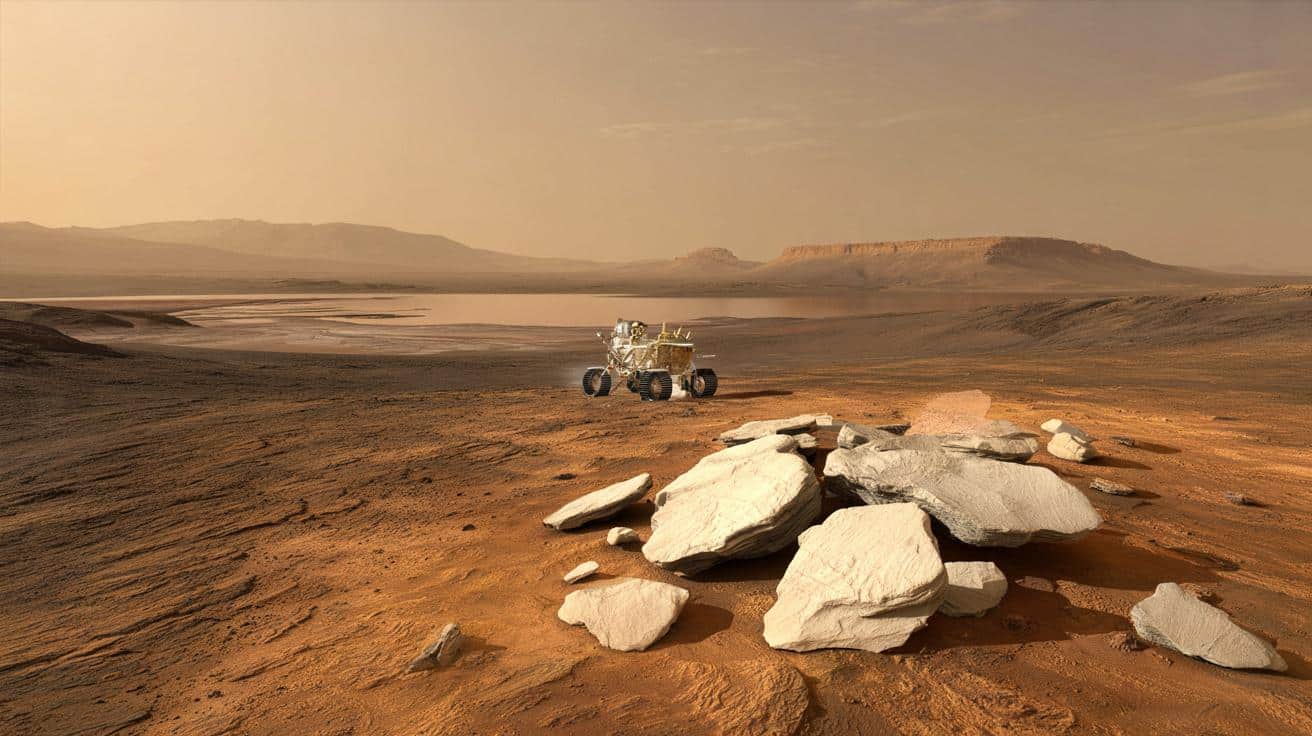
Those pale rocks, picked out by NASA’s Perseverance rover in Jezero crater, are now shaking up what scientists thought they knew about ancient Martian weather and the planet’s long-lost water.
A tropical Mars hidden in white stone
For years, the standard picture of early Mars showed a cold world, maybe dotted with short-lived lakes and streams, but rarely warm for long. New data from Jezero crater now paint something closer to a tropical episode in the distant past.
Perseverance has spotted scattered, unusually light-coloured rocks on the crater floor. Their composition is rich in kaolinite, a white clay mineral that, on Earth, typically forms in hot, rainy regions where soils are deeply leached by water.
Kaolinite on Mars points to long-lasting rainfall and a thick, active water cycle more than three billion years ago.
On our planet, kaolinite appears in places like ancient tropical soils and deeply weathered volcanic terrains. Creating it requires abundant liquid water percolating through rock over long periods. Finding the same mineral in Jezero suggests Mars once had a climate that was not just wetter, but persistently warm and humid.
What Perseverance actually measured
Perseverance has been roaming Jezero since 2021, studying rocks in what used to be a 45 km-wide lake. The pale fragments it found, sometimes called “float rocks”, do not seem firmly attached to underlying bedrock, which hints that they may have been moved from their original source.
The rover’s instruments, including SuperCam and Mastcam-Z, examined the bright fragments in detail. Their infrared spectra match the signature of kaolinite, including absorption bands linked to hydroxyl groups bonded with aluminium. Chemical measurements also show high aluminium and titanium, and very low iron, a pattern familiar to geologists who work on deeply weathered tropical soils on Earth.
The Martian rock nicknamed “Chignik” contains up to about 1.4% titanium dioxide and very little iron, a fingerprint of intense leaching by rainwater.
On Earth, titanium barely moves in water, so it tends to accumulate in soils that have been washed by heavy rainfall for millennia. The low iron content in the Martian samples suggests dissolved iron was flushed away during repeated wetting and drying, leaving behind pale, bleached material.
➡️ The umbrella storage hack that stops muddy hallway puddles forever and saves sanity
➡️ “I learned this pasta recipe the hard way, and now I never make it differently”
➡️ Scientists Discover a High-Protein Diet Could Dramatically Reduce Cholera Infections
➡️ How to calm racing thoughts at night using nothing but your breath and a glass of cold water
➡️ If you feel uneasy when there are no problems to solve, psychology explains the inner habit
Clues from Earth’s deep past
To make sense of the Jezero data, the research team compared the Martian rocks with ancient terrestrial soils. They examined:
- a 55-million-year-old Eocene paleosol near San Diego, California
- a 2.2-billion-year-old paleosol at Hekpoort, South Africa
Despite the huge age gap and different locations, the Mars samples lined up closely with these ancient tropical and subtropical soils in both infrared spectra and bulk chemistry. That similarity supports the idea that Mars once hosted intense weathering at the surface, rather than only short, underground bursts of fluid flow.
What kind of climate can create kaolinite on Mars?
Kaolinite does not form in a weekend storm. It records long-term conditions. The chemistry seen in Jezero suggests rainfall totals on ancient Mars could have exceeded 1,000 millimetres per year in some regions, comparable to modern temperate or subtropical zones on Earth.
That implies a robust water cycle, with evaporation from lakes or seas, condensation in the atmosphere, and regular precipitation falling back across the landscape. Temperatures had to be warm enough for liquid water to persist on the surface, at least seasonally, and for long stretches of time.
For Mars to produce these clays, its atmosphere likely once held far more greenhouse gases, trapping enough heat to keep water flowing.
This scenario clashes with older models that pictured ancient Mars as mostly frozen, with only brief melting events triggered by impacts or volcanic bursts. Instead, the planet may have gone through a genuine “tropical” phase, even if only confined to certain latitudes and for a limited slice of its history.
How did the white rocks get to Jezero?
The nature of the rocks now seems clear, but their journey is still a puzzle. Perseverance has not yet found any large, intact outcrop of kaolinite in Jezero itself. Instead, the white fragments appear scattered, like rubble left behind by some distant process.
Two main scenarios for their origin
| Scenario | Mechanism | Supporting evidence |
|---|---|---|
| River transport | Ancient rivers carried kaolinite-rich sediments into Jezero lake. | Orbital data show clay signatures along fossil river channels such as Neretva Vallis. |
| Impact ejecta | A meteor impact blasted kaolinite-bearing rocks from nearby highlands into the crater. | Clusters of light breccia blocks and distant clay-rich terrains point to possible source zones. |
Data from the CRISM instrument aboard Mars Reconnaissance Orbiter have highlighted several kaolinite-rich areas near Jezero’s south-western rim, sometimes just a couple of kilometres from Perseverance’s path. Other promising targets lie further afield in Nili Planum, where aluminium-rich clays overlie magnesium-rich ones. Those layered sequences suggest wide-scale, long-lived alteration of the Martian crust.
What this means for Mars’s missing water
Kaolinite does not just record past water; it can also lock that water away. The mineral structure holds hydroxyl groups and tightly bound water that only escapes at temperatures above roughly 450°C. Spectral data show that some Jezero samples still carry a strong hydration band, implying they never heated beyond that threshold.
Ancient Martian water may be stored, molecule by molecule, inside clays that have sat undisturbed for billions of years.
If kaolinite-rich terrains are widespread across Mars, then a meaningful fraction of the planet’s early atmospheric and surface water could now reside in these silent mineral reservoirs. Unlike Earth, Mars lacks active plate tectonics to recycle those clays back into the mantle and release the water again. Once trapped, much of that water stays trapped.
This process may have played a quiet but decisive role in drying the planet. While solar radiation stripped away part of the atmosphere from above, chemical weathering and clay formation may have been removing water from the climate system from below.
Habitability during Mars’s “tropical” era
The conditions that favour kaolinite formation—mildly acidic water, dissolved oxygen, steady rainfall—also align with environments that could support microbes. Lakes filling Jezero and surrounding regions would have provided stable, long-lived habitats, with chemical gradients that life can use as an energy source.
Such settings raise hopes that traces of ancient biology, if it ever took hold on Mars, might be preserved within or near these bright clay-rich rocks. Organic molecules, microfossil textures or isotopic patterns could all be hiding at microscopic scales, waiting for laboratory instruments on Earth to test them properly.
Why sample return matters next
Remote instruments can detect minerals and estimate composition, but they cannot match the sensitivity of Earth-based labs. Future missions aimed at bringing Perseverance’s samples home will be crucial for several reasons:
- measuring exact water content and hydrogen isotopes in the clays
- searching for faint organic compounds or complex carbon structures
- pinning down precise ages of rock formation and alteration
- testing models of early Martian climate with real, physical material
Such measurements would show whether the “tropical” climate phase was a short, intense pulse or a drawn-out chapter of Martian history, and how quickly conditions shifted towards the dry, thin-atmosphere planet we see today.
Key terms and ideas behind the findings
For readers less familiar with planetary geology, a few concepts help make sense of these results. A “paleosol” is simply an ancient soil that has hardened into rock. On Earth, paleosols preserve snapshots of past climates, including rainfall and temperature. When Mars rocks resemble terrestrial paleosols, they suggest similar weathering processes and, by extension, similar environmental conditions.
Another key term is “hydrological cycle”. This is the continuous circulation of water between surface, subsurface and atmosphere. On early Mars, a vigorous cycle would involve evaporation from lakes, cloud formation, snow or rain, runoff into rivers and lakes, and infiltration into the ground. Clay minerals like kaolinite form part of the long-term memory of that cycle, capturing how intense and persistent it once was.
Climate models of early Mars now need to satisfy stricter constraints. They must reproduce not only valley networks and ancient shorelines, but also the specific chemistry of deeply weathered clays. Simulations that include thicker atmospheres rich in carbon dioxide, possibly boosted by hydrogen or methane, are being re-examined in light of the Jezero data. Researchers are testing how long such warm periods could last and how quickly they would collapse as the atmosphere thinned.
These white rocks, sitting quietly in a dusty crater, are forcing scientists to picture a very different Mars: one with thick clouds, pounding rain and slowly bleaching soils, a planet that may have been far closer to Earth’s moods than its frozen surface suggests today.