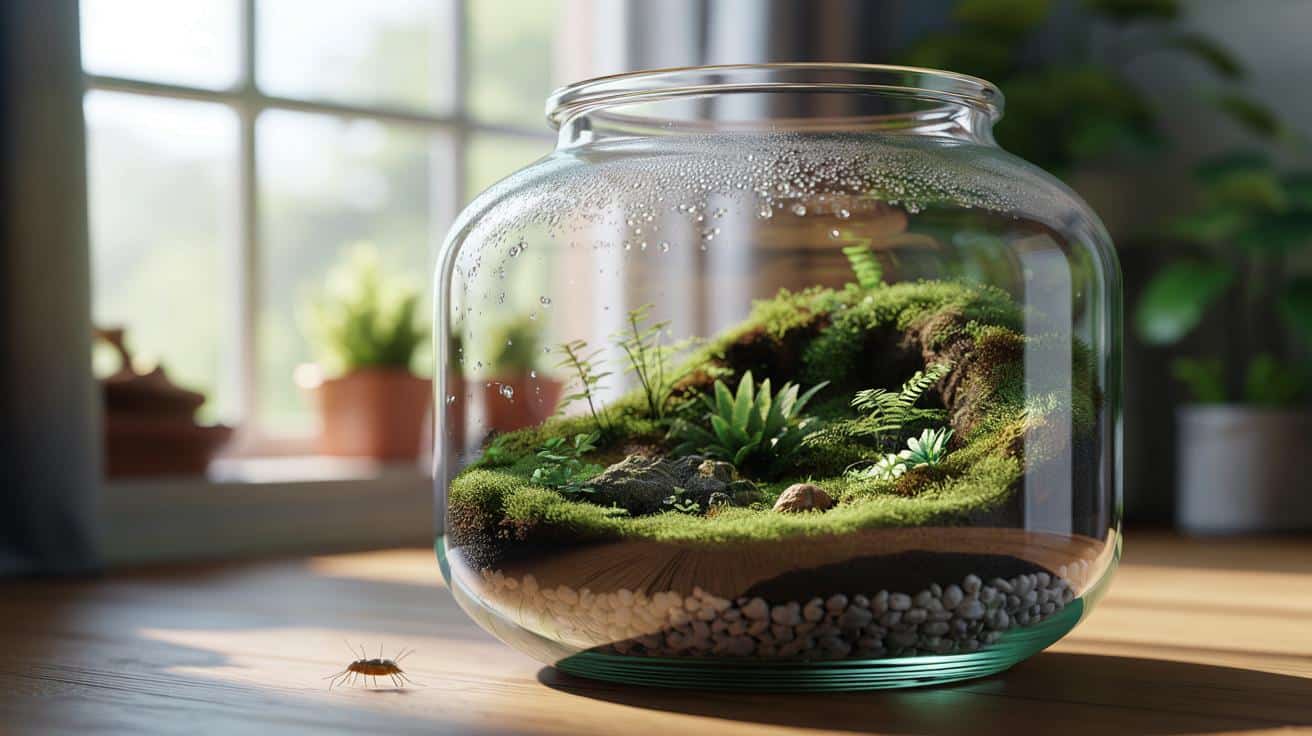
On the windowsill, a thumb-sized fern straightened like it had somewhere to be, while tiny beads of water slid down the glass and vanished back into the soil. I didn’t touch it. I didn’t pour anything in or take anything out. The little world just… kept going. We’ve all had that moment when a houseplant wilts and guilt hits like a calendar alert you snoozed three times. This isn’t that. This is a sealed, self-watering ecosystem you can build in an afternoon and then mostly forget about, without the usual guilt. A living glass world that runs itself. And it never asks for a reminder.
The quiet science inside a glass jar
Morning light warms the glass, and a soft mist climbs the inside like breath on a window. At night, the fog fades as the jar cools. There’s a hush in a sealed jar that feels like weather on a tiny planet. Plants exhale moisture, the walls sweat, drops slide back to the roots. It’s not magic. It’s the water cycle—shrunk to the size of your palm.
A British man, David Latimer, planted a bottle garden in 1960 and sealed it for good in 1972. He opened it once to add water, then let it ride for decades under a skylight. The plant inside—Tradescantia—kept growing, recycling its own air and moisture. His jar was big and lucky, sure, yet the principle scales down. Keep the inputs right, and a terrarium can stay stable for years, not weeks.
Here’s what’s happening behind the glass. Plants transpire, releasing water vapor that condenses and rains back down. Microbes and fungi break down fallen leaves into nutrients, and springtail “cleanup crews” nibble at mold before it wins. Oxygen and carbon dioxide trade places in a steady rhythm tied to light. The trick is balance: gentle light, a sealed lid, a living soil layer, and just enough water to spark the cycle without drowning it.
Build one that balances itself
Pick a clear glass jar with a proper lid—jam jar, cookie jar, even a demijohn. Rinse it, then wipe the inside until squeaky; residue can feed algae. Start with the container that seals well, or nothing else matters. Pour in 2–3 cm of rinsed pebbles or LECA for drainage. Add a thin layer of horticultural charcoal to filter funk. Lay a mesh circle on top to keep soil from sinking. Then add 6–10 cm of substrate: 60% coco coir, 20% leaf mold or compost, 20% perlite. Moisten to “wrung sponge.”
Build terrain with a slight slope so the back looks deeper. Tuck in small humidity lovers: moss, fittonia, peperomia, tiny ferns, pilea. Press roots into the soil—not against the glass. Mist once, lightly. Pop in springtails (a teaspoon of culture) to patrol mold. Seal the lid. Place in bright, indirect light—near a window but not in a midday beam. Then watch for three days before doing anything at all.
Common mistakes? Overwatering, sunny windows that cook the jar, and trying to cram a cactus into a rainforest. I get it. We want it lush on day one. Let it be scruffy instead. We’ve all had that moment where we keep tinkering because silence feels like neglect. Let’s be honest: nobody actually does this every day. Start small, avoid direct afternoon sun, and resist opening the lid “just to check.” If the glass drips nonstop or smells swampy, that’s a gentle nudge to adjust.
“Aim for a terrarium that fogs at dawn and clears by lunch. That’s the heartbeat of balance.”
- Light check: bright room, no harsh beam that heats the glass.
- Moisture check: mist at sunrise, clarity by midday, not constant drizzle.
- Smell check: forest-floor clean, never sour or rotten.
- Growth check: slow, steady leaves; no yellowing stampede.
- Cleanup crew: springtails bouncing like static on the soil surface.
Years in a jar
The first weeks are the wobble. You’re tuning a radio more than building furniture. If the glass stays wet all day, crack the lid for 12 hours to vent, then reseal. If it’s bone dry by noon, add a teaspoon or two of water at the edge with a dropper. Trim a leaf here, tuck a stray root there. Then step back. The best terrarium is the one you barely touch. Give it a home where light is consistent—a bookcase near a window, a desk that never sees harsh glare. Patience does most of the work from here.
| Point clé | Détail | Intérêt pour le lecteur |
|---|---|---|
| Layering order | Drainage (LECA/pebbles) → charcoal → mesh → living substrate | Prevents rot, keeps nutrients cycling cleanly |
| Right plants | Moss, fittonia, small ferns, pilea; avoid succulents and cacti | Improves survival and self-watering rhythm |
| Balance signal | Fog in the morning, clear by midday, fresh forest smell | Quick daily read on the ecosystem’s health |
FAQ :
- What size jar works best for a first build?Go for 2–5 liters. Big enough to buffer moisture swings, small enough to place out of direct sun.
- Do I really need springtails?They’re tiny but mighty. They eat mold before it spreads and help recycle waste. For closed terrariums, they’re the easiest insurance.
- How often should I open the lid?Ideally, never. Only crack it to correct a clear problem like nonstop condensation or a sour smell.
- Which light is safest?Bright, indirect daylight or a gentle LED grow light set a few feet away. Avoid hot window beams that heat the glass.
- What if mold shows up?A little is normal at first. Add or boost springtails, remove visibly fuzzy patches with tweezers, and reduce moisture by venting for a day.
➡️ The Norfolk home of the grandmother of Diana, Princess of Wales, has come to the market
➡️ A new set of eight spacecraft images reveals the interstellar comet 3I ATLAS in astonishing clarity
➡️ The overlooked link between mental load and physical fatigue
➡️ UK Ends Retirement at 67 Historic Shakeup New Pension Age Officially Announced
➡️ The finding of white rocks on Mars supports the idea of a tropical climate 3 billion years ago
➡️ The entryway pause that clears clutter: why a few seconds prevent hallway mess